Emre Ishik                       
          fractal                 


Click to see me...

Solar MHD Group home page

Current position...
Postdoctoral fellow at the Max Planck Institute for Solar System Research in Katlenburg-Lindau, a village located 30 km northwest of Göttingen, Germany.
I have recently defended my thesis after a 3-year PhD study, as part of
International Max Planck Research School on the Physical Processes in the Solar System and Beyond.

Contact

Curriculum vitae

Work

I started my PhD in January 21st, 2005, working mainly with Manfred Schüssler within the research group Solar and Stellar Magnetohydrodynamics. I have defended my thesis on January 18th, 2008. My other supervisors were Dieter Schmitt and Sami K. Solanki. An overview of my research is below...

PhD thesis (pdf; 13 MB)

Defence talk (pdf; 19 MB -with embedded animations- no problem with Adobe Reader v7.0)


Magnetic flux transport on active cool stars

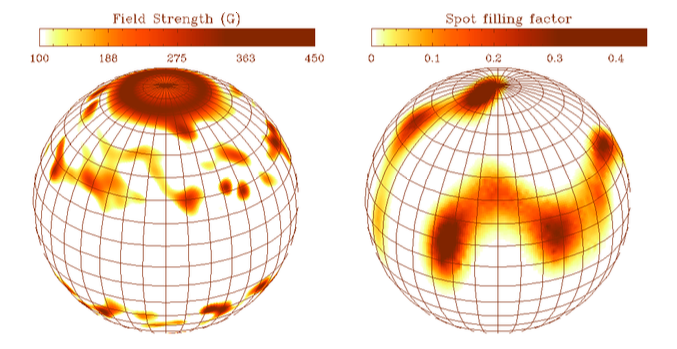
I have carried out numerical investigations concerning the effects of large-scale surface flows on the lifetimes and structure of starspots. See Astron. & Astrophys. vol. 464, pp. 1049-1057 (2007) for more.. The image to the left shows the simulated evolution of a bipolar magnetic region (BMR) of the same fractional area of a large solar BMR, on a subgiant star of about 3 times the solar radius, and having the observed differential rotation of the active subgiant component of HR 1099. The structure emerges at 70 degrees latitude and lives for about two years. You may have a look on how the simulations give an idea about the formation/maintenance of a polar spot on a dwarf and on a subgiant star, when there is a supply of high-latitude flux due to random emergence of six tilted bipolar regions. Collaborators: M. Schüssler and S. K. Solanki.

For another key result of the study, see here.

Talk at the 9th MHD Days in Heidelberg (2006).
Talk at the 15th National Astronomy Congress in Istanbul (2006; in Turkish).
Poster at the IAU General Assembly, JD08 "Solar and stellar activity cycles" (2006).


The effects of external flows on a toroidal flux tube at the bottom of the solar convection zone

How significant are the effects of longitudinal and perpendicular flows on the equilibrium and dynamics of flux tubes, in terms of magnetic flux storage in the solar interior? Investigation of this problem involves critical tests for the operation of a deep-seated dynamo in the Sun (see below). See Chapter 3 of my thesis (above) if you are interested in.
See the poster presented in the 12th European Solar Physics Meeting (Freiburg im Breisgau, Germany). Collaborators: V. Holzwarth and M. Schüssler.

A coupled model of magnetic field generation and transport in cool stars

I have developed a unifying model that considers physical processes for the generation, emergence, and surface transport of magnetic flux in the Sun and other cool stars. The 'other' cool stars that I consider for the time being are Sun-like stars which rotate faster than the Sun, the so-called 'young suns'.. For more information, see here... Collaborators: D. Schmitt and M. Schüssler.
For the first results see, Astron. Nachr. vol. 328, pp. 1111-1113. The supplementary animations referred to in the paper can be reached below.


Rotation period: 27 days                 10 days                                 2 days


Where am I from?..
Many places in Turkey, such as Antalya, Izmir, Kütahya, Gaziantep, Trabzon, and of course, Istanbul..

Note: If you want to pronounce my surname correctly, try like "ishik" in English or "ischik" in German or "ichique" in French. :)) If you prefer exactness, say both "i"s like "a" in "fear"!.. Well, nevermind.. :)


Last modified: Thu Sep 25 22:39:59 EEST 2008